Saturday, May 3, 2014

Demolition Is Mostly Complete

The house that we bought is now nearly completely gutted.  Last week, the first new structural elements (some metal beams that will join the floors to the walls) were added.  Holes were also dug for the foundation of a structural wall we are adding to support the stairs leading to an apartment above the bar. Opening the holes was a bit of a nervous moment for us because we were required to hire an archeologist to be present for the process. Of course, discovering anything below the floor of the house could have been a major setback to the progress of our construction. Fortunately, there was nothing more then some relatively recent (maybe 100 years) remains of the house predating ours. There is some more digging to be done, but so far it does not appear that we will have archeological discoveries.


Having the crane has already helped move things along nicely.  The old stairs were supported by a stone wall in the interior of the house.  Moving the mess of stones created when that wall was demolished would have been a huge job without the crane.


There is still a lot of work to do, but it's nice to see the space finally opened up.  I can stand there now and dream about what the bar will look and feel like.  It's an exciting process, and it gets easier to imagine as more work is completed.


Thursday, April 10, 2014

What Can You Say About a Person From the Size of Their Crane?

Things on the construction site were delayed a little by the municipality.  They took their time giving us a construction license, and we also had some difficulty with the electric company getting a connection.  Today, thinks are finally moving again, and to kick it off we got a very special delivery!

A crane!  Ready to do work for me!
Ever since I was a child, I've always loved cranes.  My favorite cranes are the mobile variety...  The kind you can just drive up on a whim and lift anything you see.

For me, cranes have a slightly magical superhero quality to them, but I also like to imagine the havoc you could reap if you had a really big one and a mind for mischief.  I know that the world of physics places real limits on what cranes can do, but in my childhood imagination, limits don't matter.

Want to rob a bank?  Why bother showing up with a gun when you can drive up with a crane and take the whole building?

Make me mad?  No problem, I'll just put your car on your house...  Make me REALLY mad?  OK, then I put your house on your car!

Anyway, I have endless fantasies about how great it would be if I just had a crane at my disposal, and today, my dream became a reality!  Thanks to the wonderfully named company 'RENTAGRU'  ('grua' is Portuguese for crane...  get it?  'RENT-A-GRU'... clever right?)

Rent me
When our contractor told us he would be employing a crane, we had no idea that he meant to get the biggest one he could fit in the space.  Literally, look at the picture below.  This is the space in the back of our garden, it's a small, but by no means tiny area...  It's about the size of a large single car garage, or (as shown in the picture) one very large crane foot!

Crane foot
After they attached the first segment of the crane tower to the crane foot - there are probably more technical names for this stuff, but somehow I don't think there should be.  Anyway, after they put the crane tower on the crane foot, they piled loads of concrete anchors on it, and it looked like this.  For reference, the wall in the back is about 3 meters high (almost 10 ft).

Crane foot under anchors with crane tower protruding.
 By any measure, this is a big crane.  It's bigger then the house we are re-building!


It seems a bit silly to have such a giant thing.  I feel almost ashamed, as if it's somehow 'unjust'... How can I have so much crane when so many poor sad people have so little?  I feel guilty, but I don't care.  I love my crane!  So much so that I spent the whole day just watching them put it together.  I even made some videos:


Saturday, March 8, 2014

Time Lapse TerraPlan

Construction has just begun on the house.  Right now, it's actually deconstruction (demolition), but soon, hopefully we can see some progress.  To document the result, we decided to make a 'time lapse' video, and after some investigation, stumbled upon this nifty camera:  Brinno.


Before we set it up, I did a few experiments to understand the different settings, and get an idea of how it works.  Here's one of me beating the crap out of my friend at chess (sorry, I know it's rude to gloat).


The Brinno camera is pretty cool, it has an easy interface, and lots of settings.  Basically, you just tell it the interval that you want it to snap pictures, and it does the rest, resulting in a nice AVI file with your resulting movie.  You can set the resolution of the movie, and also the frames per second.

There were only two problems with the camera for us, first, the camera has a light sensor to adjust the shutter speed, but it only takes one reading when you start the film.  This is a problem if you are going to be taking pictures outdoors over a long period because the light conditions are likely to change.  In our case, we will be taking pictures once every 4 hours, which means that one picture will be early morning, one afternoon, and one late afternoon (as well as some at night which I plan to edit out latter).  Because there will be different light conditions some of the frames will be over or underexposed.  The second issue is one that Brinno has recently fixed.  They added a setting that allows you to limit the operation to certain times of day which would have been very useful for us because we could set it to avoid the nighttime shots.  It's not really a problem because I can edit out the night shots, but I wish I had know that they distributed the fix via a firmware update... I just discovered now.

I bought the optional waterproof box for the camera and a wall mount.  We decided that the best place to view the progress of construction would be from the high back wall.  No problem for me, nothing quite as fun as working with power tools on a thin ledge high above the ground!


Having the camera on a high ledge also makes it hard to see, and difficult to get at adding a little protection.


Sunday, February 16, 2014

Saving Homeboy

One of the main reasons for selecting this house was the amazing south facing garden.  The climate in Porto is so pleasant that most of the year, people will want to be outside.  Therefore, having a good garden space was an early requirement for us.  In Porto, gardens are common in many of the newer old neighborhoods (19th century), they are less common in the more ancient/medieval parts of the city.

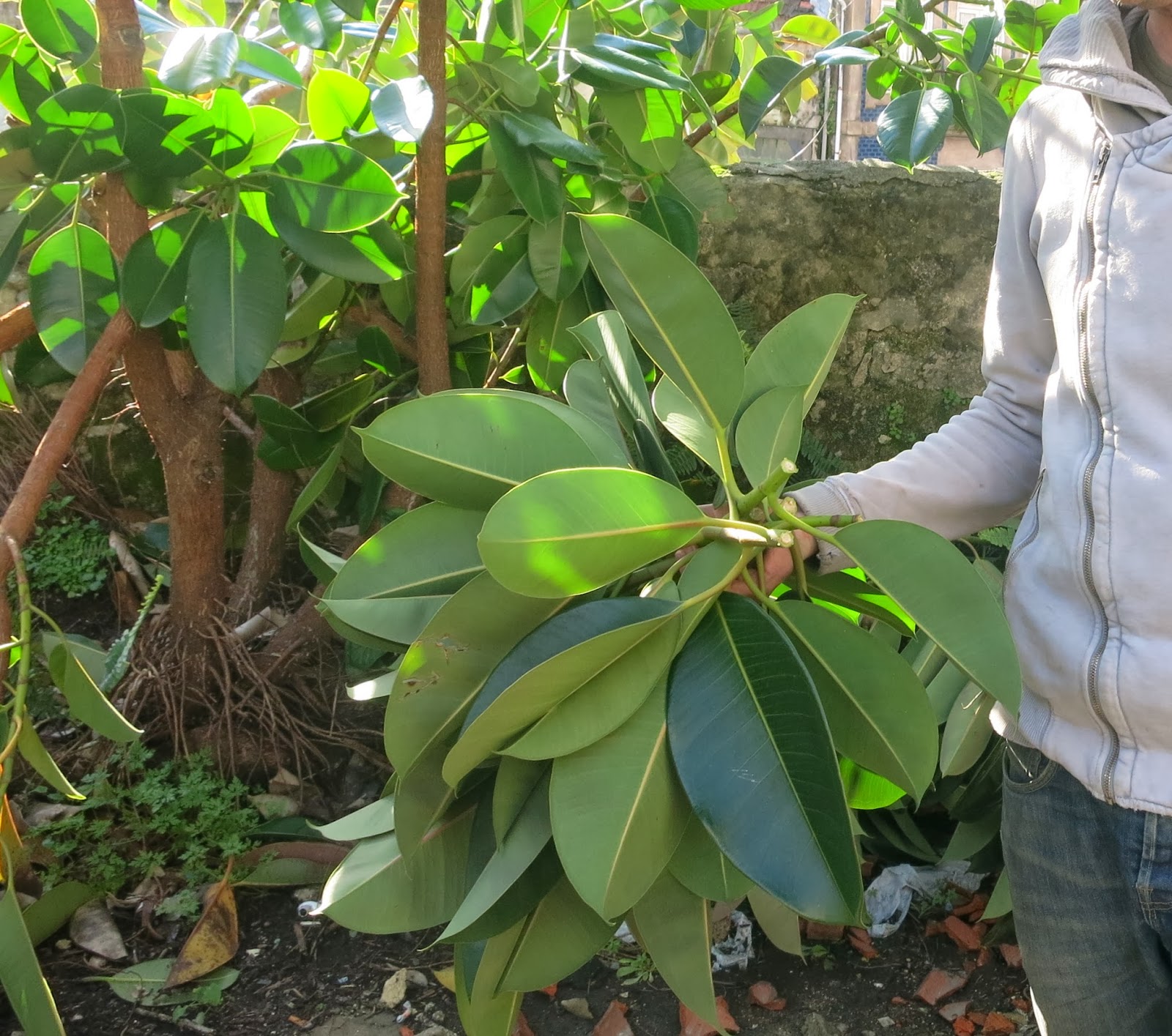
Of course, in it's current condition, the garden doesn't look like much.   The last owner of the house paved it over with concrete (illegally), added an illegal workshop structure, and then a very aggressive rubber plant took over... concrete be damned!

Yes, one plant... really ONE plant!
Rubber plants (Ficus Elastica) are incredibly hardy things.  Given the right conditions, they can grow to be massive trees, and the 'right conditions' are very flexible.  No water, no sunlight... NO PROBLEM (generally speaking).  Most plants would give up rather than try to grow on top of impenetrable concrete... but rubber plants don't give a fuck!  Ours just spread out his roots horizontally across the top of the concrete.

Our original goal was to keep our plant, of course his wild growth needed to be tamed, but rubber plants are really beautiful things, and he was holding down the fort long before we arrived on the scene.  We even named him; 'Homeboy'.  Unfortunately, city regulations set strict limits on impenetrable coverage and we are required to remove all the concrete (which had been laid illegally) under Homeboy.  Hardy as he is (original gangsta' really), there is no way he will survive the process.

But there is a way to keep him.  Homeboy will be saved or at least, propagated into little clone Homboyz!  Rubber plants can be propagated though cuttings in addition to sprouting from seeds, so today, I collected a few.
Propagating plants from cuttings is not difficult, but this is my first attempt so I spent some time on the internet and spoke with the guys at the local gardening shop.
Tools of the trade
Although there are methods that don't require it, most sources I saw suggested using the 'rooting hormone' Auxin.  I've read before how plants regulate their growth activities and even communicate with other plants using hormones.  It's quite fascinating really, and particularly impressive that we have isolated the exact chemical compounds that plants use to do it.
Portuguese rooting hormone
Anyway, the process is pretty simple, you cut the plants below a leaf segment, dip the cut edge in some of this funky hormone stuff, and then plant it into very moist place (or directly into water, I'm trying both ways) until the roots start to sprout.  You can also spur the process along by pruning the leaves in half so the plant gets the impulse to regenerate the damaged ends.

I'll keep you posted on the progress of our 5 little Homeboyz.  I really hope we get at least one rooting plant to keep beat alive!


Tuesday, February 11, 2014

Groundbreaking!!!

The first shovel.
It's been a two years since we first hatched a plan to create a bar in Porto... one year since we bought the house.   At times, the planning/approval phase seemed endless, but that was nothing compared to the selection and negotiation for a general contractor!  Finally, that is all behind us.  Today, we had a small ceremony to officially break ground.

From this point forward, something is going to be built.  Terraplana is coming into the world.  It's exciting, and a bit scary, but we still believe in the original goal, and nothing in the process has been so difficult as waiting to see the result.

Construction is estimated to take less than 8 months.  Of course we will be following the process closely.  There is plenty to keep us busy during construction;  we still have a lot of work to equip and furnish the bar, and some of that can begin now, we are also designing the logo, media and webpage.

Today is a milestone, so we celebrate a little.  Tomorrow, back to work!


Thursday, January 16, 2014

The Olive Harvest

A good friend of ours lives in Porto, but his family shares a holiday house in the Douro river valley.  This is somewhat common in Portugal because as families migrated to the cities, it was not unusual to hold onto the family farm.  My friends family built a small guest house on the family plot which also contains a few hectares of vines, and a small plot of olive trees.  They pay people from the village to help tend the vines, and then sell the grapes into the local collective which then brokers the grapes to the local wineries.  The olive trees require only a little pruning every year, but the harvest is hard work.  Since they only have a few trees (less then 30) they do the harvest themselves.  This year, they invited me to help.

For my friend's family, I think the harvest is seen as a bit of a chore.  It's done in January, so it's usually cold and rainy, and the main work is basically beating a tree with a stick while a shower of olives, leaves, dewdrops, and anything else in the tree showers down on your head.  I think they were a little surprised when I told them that I was interested in helping, and they probably thought that I would get tired of it quick, but for a city boy like me, it's great to get out in the country and to a day of really physical work.

We started the morning right at sun-up, and as expected, it was foggy, damp, and a little cold.

Hard to see how spectacularly beautiful it is with the fog
Harvesting olives hasn't changed since ancient times.  There are three steps, first you spread a sheet on the ground, then you attach the tree with a stick shaking the olives loose.  Finally, you lift the sheet, remove the leaves and twigs, and collect the olives in a bucket.

First tree
Once we had done a few trees, we had things down to a pretty well defined routine, and we could complete a tree in about 30 minutes.  Some trees are bigger then others, and some are growing on difficult, uneven ground, so there was always some variety, and an occasional challenge.

Result from one large tree
We worked from sun up until the light ran out (about 7:30 until 6:00 this time of year).  After a day and a half, we had filled one large box which probably holds a little over 400kg:

The olives are processed by the town's local collective.  It is possible to schedule with them so that you get the oil from the exact olives you bring, but we were happy to just exchange our fresh olives for the collective oil.


At lunch, we tried some of the collective oil from last year.  Words cannot describe how incredible it is.  It has such a beautiful golden color, and the flavor is so nice that I can easily imagine being happy with a lunch of nothing but bread and oil, or even drinking some straight!  As payment for my labor, they are going to give me 5 or 6 liters which would normally last a year, but this stuff is so good that I think our intake of oil might go up.


Thursday, December 5, 2013

Why Porto?

Earlier this year, there was a post describing why we chose Portugal for TerraPlana (Why Portugal?).   The post does a good job of explaining our thought process, but it does not explain why we settled in city of Porto.  Portugal is a small country (even in European terms) but it's big enough, and there are a few cities.  The largest, and most well know city in Portugal is the capital city Lisbon.  Porto is the second largest city, but by most measures it is still only about half the size of Lisbon.  There are other cities in Portugal, but they are mostly significantly smaller, so for us, the choice really came down to Lisbon vs Porto.

Ribera, the old city center of Porto

 Among the Portuguese, most people hold a strong preference for one city over the other (Lisbon or Porto) and they are very different in geography, architecture, and in general 'feeling'.  In some ways, the rivalry between the cities is not unlike that between San Francisco and Los Angeles.

The two cities are similar in age (that is, they are both ancient; pre-Roman) but Porto has a slightly older feel, and this is probably because Lisbon was completely leveled by a major earthquake in 1755, and subsequently rebuilt.  Porto has streets that retain a slightly medieval feel.   Whereas Lisbon is full of broad avenues, the old city of Porto is a warren of tiny cobblestone streets.

The river is a central, defining feature in both cities.  Lisbon has the Tagus (Tejo in Portuguese) and Porto has the Douro.  The Tejo meets Lisbon on a broad flat estuary, whereas Porto perches on steep cliffs over the Douro.  Lisbon has a very characteristic (and beautiful) light that results from the sunshine over the Tejo river, and the amphitheater  created by the city's hills.  Porto always feels a little more dark and medieval.  Lisbon's many fans never fail to point this out, and they usually highlight the warmer weather in Lisbon too.  There is only 300 km distance between the two cities, and they both have a southern European climate, however Lisbon is normally a few degrees warmer (which can be a problem in the hot summers).

Porto as seen from the far side of the river.

So why did we chose Porto over Lisbon?  Partly, the choice was economic.  In the last few years, Lisbon has become more of a tourist and economic center for Portugal.   While that may seem a good thing when choosing to locate a bar, there is one significant downside.  Property prices, and expenses in general are substantially higher in Lisbon.  Additionally, a small house like the one which is to become TerraPlana would be very hard to find in Lisbon.  The buildings in downtown Lisbon are generally bigger which magnifies the higher price and would make our project more difficult.

Another reason to chose Porto is the young artistic feel of the city.  Although both cities have large universities, the University of Porto has more of an impact on it's city for two reasons.  First, the relative size of the university compared to the overall population is larger, so it appears that there are more young people around.  Second, University of Porto is one of the most common destinations for foreign students in the Erasmus Programme  (a unified European foreign student program).  Consequently, there are not just a lot of young people around, but there are a lot of young foreigners.  Foreign students are by definition far from home, so they tend to focus a bit more on creating and enjoying a social circle.  For this reason, they are a little more visible and active in the city.  This has a very positive impact on the feeling of Porto.

Finally, and probably most important for us is the proximity of Porto to the sea.  Although technically Porto does not extend to the seafront, it has grown into the surrounding towns and fishing villages so that there is really no break in the urban area right down to the sea.   Lisbon is just a little bit farther from the ocean, but it makes a huge difference.  From the center of Porto, 20 minutes on a bicycle will deliver you here:

The stunning seafront.
There are some fantastic beaches near Lisbon, but even the closest will take more then 30 minutes by car.  During the summer, getting to a good beach from Lisbon can easily take more then and hour.  Sometimes the beaches in Porto get crowded, and the sea breeze can be strong, but you don't have to go far to find an amazing beach, and if you go just a short distance outside of the city, you can always find a quiet spot.  And the surfing is great too!